Hire the international candidate. Skip the lottery entirely.
Your TA team has spent six months courting an international candidate. Then the H-1B lottery rejects them, the 2025 H-1B fee (vacated June 2026) scares your CFO, or the OPT clock runs out. The hire dies — not because the candidate wasn't right, but because the visa system is. O1DMatch is the alternative path: hire O-1 talent with a one-page interest letter, no sponsorship liability, full referral tracking and analytics built in.
Built by an immigration attorney with 15+ years of agent-based O-1 visa work. Agent-based petitions for talent at Goldman Sachs, Netflix, ESPN, Insight Global, the Raiders, the Packers, NASCAR, and others.
Agent-based O-1 / P-1 work has supported talent across these organizations










 The Difference
One one-page letter replaces the entire H-1B sponsorship machine.
Most HR leaders hear "international hire" and immediately think H-1B: lottery roulette, the 2025 H-1B fee (vacated June 2026), six-month timeline, and your firm becomes the legal sponsor responsible for the candidate's status. None of that applies to the O-1.
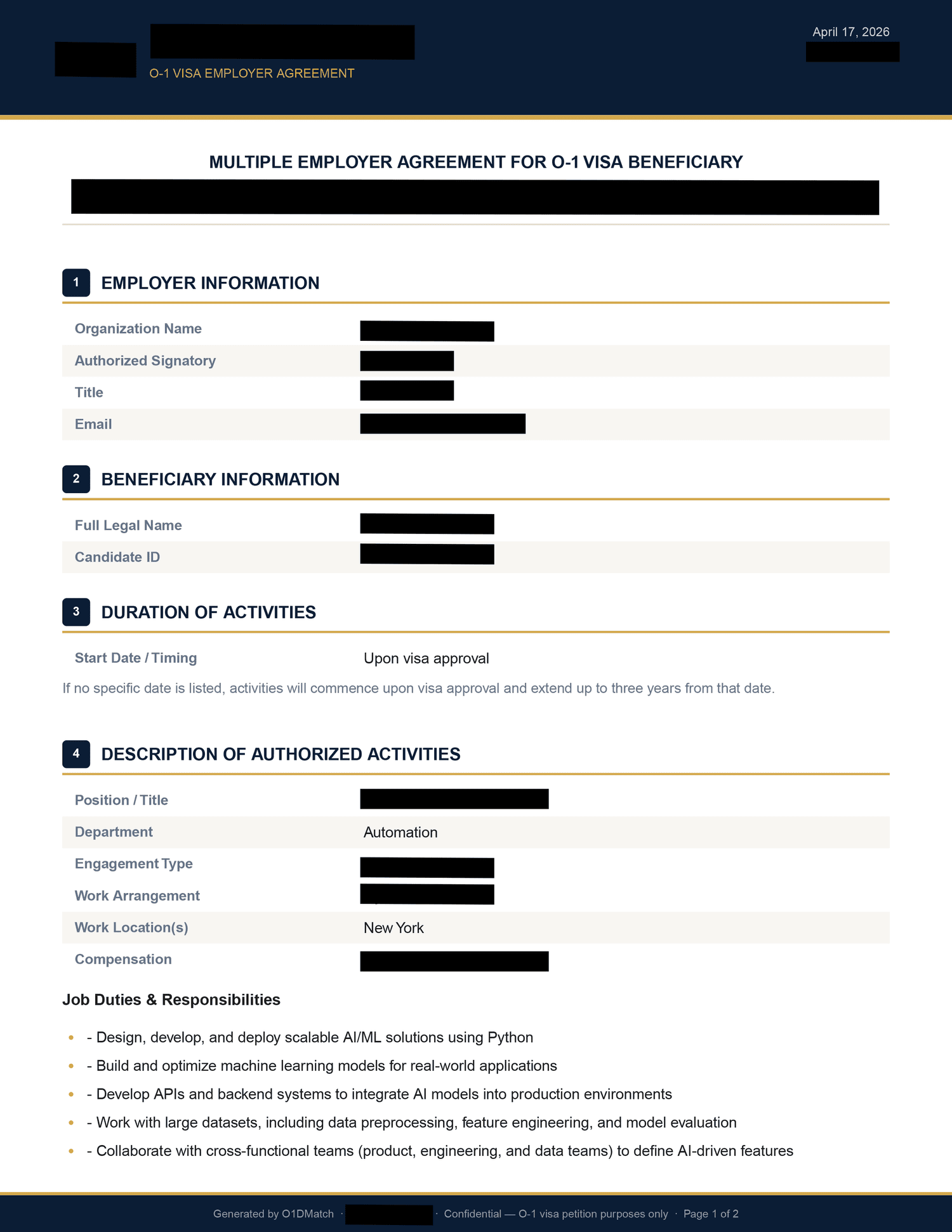
Under the agent-based O-1 model, your company isn't the petitioner. You sign a one-page interest letter expressing intent to engage the candidate. The candidate petitions through an agent through an authorized agent. You don't pay USCIS, you don't take on sponsorship liability, you don't manage the legal process. You hire the person, just like any other hire.
The candidate gets approved in 15 days with premium processing. They show up to start work. Your team treats it like any other hire date — except you didn't sit through the lottery to get there.
What's BrokenThe three places international hiring breaks for HR teams.
If your team has tried to hire international talent through the H-1B in the last few years, these will sound familiar. They're structural problems with how the U.S. immigration system meets corporate hiring — not problems with your firm. But they cost your business hires, candidates, and offer-letter velocity every quarter.
i
H-1B lottery roulette
Roughly one in four candidates is selected, regardless of qualification. Your team invests months in courting a candidate, makes the offer, files the petition, and then loses them to a coin flip. The candidate moves on to a country that wanted them, and your role goes back to square one.
ii
the 2025 H-1B fee (vacated June 2026)
As of 2025, new H-1B petitions filed from overseas carry the 2025 H-1B fee (vacated June 2026). That's a six-figure line item your CFO has to approve before you've even confirmed the hire. Most companies stop sponsoring international candidates at this price point, and qualified hires walk.
iii
No referral pipeline visibility
An employee refers their foreign friend, your team makes contact, the candidate is qualified — and then nothing connects the dots. You can't track which international referrals are visa-ready, where each candidate is in the petition pipeline, or which referral source produced the highest-quality hires.
What O1DMatch Does for Your TA TeamA complete international hiring layer that doesn't make your firm the sponsor.
O1DMatch sits between your HR team and the legal infrastructure of the O-1 visa. Your team identifies and decides on candidates. We handle the matching mechanics, the interest letter formatting, and the pipeline visibility. Four ways the partnership shows up in your hiring practice:
Reviewed O-1-ready candidates
Browse a continuously growing pool of international talent already reviewed against the 8 USCIS criteria. Every candidate you see has a eligibility review, an evidence package, and a agent-based petition pathway in motion. You hire from a pool where the visa work is already underway.
Hire without sponsorship liability
Your company signs a one-page interest letter. The candidate petitions through an agent through an authorized agent. You don't pay USCIS, don't take on sponsorship liability, and don't manage the legal process. The visa is the candidate's responsibility — you just hire the person.
Employee referral tracking
When an existing employee refers their foreign friend, the referral is tagged in O1DMatch with full attribution. Your TA team sees who referred whom, where each referred candidate is in the visa pipeline, and which employee referrers consistently produce the highest-quality hires.
Pipeline analytics for leadership
Reporting dashboards designed for the conversation you have with your CHRO and CEO. International hiring volume, time-to-hire by visa pathway, referral source ROI, regional distribution, role-level data. The numbers you need to defend the budget and forecast the pipeline.
Partnership ModelsThree ways to partner. We'll figure out which one fits team on the call.
Every TA team has a different international hiring volume, internal structure, and analytics maturity. Rather than pre-pricing a one-size-fits-all program, we sit down with your team to build a partnership shape that fits your business. Here are the three primary structures we offer — most teams pick one, some combine over time.
Model 01 · Referral TrackingTrack international referrals through the visa pipeline
Lowest-commitment partnership. Your TA team gets a referral tracking layer for international candidates — visibility into where each referred international hire is in the visa pipeline, source attribution, and conversion analytics. No subscription seats, just the tracking system.
→ Employee referral attribution and tracking
→ Pipeline status visibility per candidate
→ Quarterly analytics reports
→ Best for teams with low international volume but want better visibility
Model 02 · Talent Pool AccessBrowse and engage reviewed O-1-ready candidates
Your TA team gets seat-based access to the platform — browse the international candidate pool, filter by industry, review, and field, and engage candidates directly. Plus all the referral tracking and analytics from Model 01. The full inbound + outbound talent layer.
→ Unlimited candidate browsing and engagement
→ Filter by industry, review, and field
→ Interest letter delivery from your firm
→ Best for mid-size teams with steady international hiring volume
Model 03 · Strategic PartnershipWhite-labeled international hiring infrastructure
The most integrated option. O1DMatch's platform is white-labeled inside your firm's HRIS and ATS workflow — your TA team experiences international hiring as a native part of their existing tools. Custom branding, custom analytics, deep integration. Plus everything in Models 01 and 02.
→ HRIS / ATS integration
→ Custom branding inside your toolchain
→ Dedicated success manager
→ Best for large enterprises with strategic international hiring goals
Why we don't publish standardized pricing: partnership terms depend on your company's size, current international hiring volume, your existing visa programs, and which model fits your TA team. A 200-person Series B startup making 5 international hires per year has a different optimal structure than a Fortune 500 with a global mobility team and 200+ international hires annually. The 30-minute strategy call is where we figure out which model fits, and what the actual numbers look like for your team.
Book Your Partnership CallTell us about your TA team. We'll set up the call.
A 30-minute strategy call to walk through your team's international hiring volume, your existing visa programs, and which partnership model would compound for your business. No pitch deck, no commitment — just a conversation about which of the three models would actually move offer-letter velocity for your team.
HR / Talent Acquisition partnership inquiry
Reviewed by the O1DMatch partnerships team within 1 business day. We'll respond to schedule the call.
Honest answers about how this partnership actually works.
If you have a question that isn't covered here, send it via the form above and we'll address it on the call.
What's the difference between H-1B and O-1 sponsorship from our company's perspective?
Big difference. With H-1B, your company is the petitioner — meaning your firm files Form I-129, pays USCIS (the 2025 fee on new petitions filed from overseas was vacated in June 2026), takes on sponsorship liability, and manages the legal process. The candidate's status is tied to your firm.
With agent-based O-1, your company doesn't sponsor anything. The candidate petitions through an agent through an authorized agent. Your role is one signed letter expressing intent to engage them. No USCIS payment, no sponsorship liability, no legal process to manage. From a hiring-mechanics perspective, it's much closer to hiring a U.S. citizen.
Is the O-1 visa really an option for our typical candidates, or only for celebrities?
Common misconception. The O-1 standard is "extraordinary ability," but USCIS defines that as meeting 3 of 8 criteria — and the criteria are broader than most HR teams realize. Conference talks, peer review, trade publications, salary above peers, critical role at a recognized company, original contributions to a field, awards (industry awards count, not just Nobels), and selective memberships all qualify.
Most senior professionals at a tech, finance, biotech, or media firm already meet 3 of the 8. The platform's AI reviews each candidate so you know where they stand before you make an offer.
How does the employee referral tracking actually work?
When an existing employee refers a foreign friend or colleague, your TA team enters the referral into O1DMatch. The referred candidate is tagged with the referring employee's name. From that point, every step the candidate takes — profile build, eligibility review, employer match, interest letter, petition filing — is visible in your dashboard, attributed to the original referrer.
Quarterly analytics show which employees are referring the highest-quality international talent, which referral sources convert fastest, and where each candidate sits in the pipeline. Your CHRO has real numbers to defend the international hiring strategy at exec reviews.
What's the actual timeline from interest letter to start date?
Faster than H-1B by a wide margin. Once you sign the interest letter, the candidate's authorized agent files the petition. With premium processing ($2,805 USCIS fee, paid by the candidate or their attorney — not your firm), USCIS adjudicates within 15 business days. After approval, the candidate goes through a consular interview at a U.S. embassy, which typically takes another 2–6 weeks depending on country. Total: usually 30–60 days from interest letter to start date.
Compare to H-1B: lottery in March, work-start October 1 at earliest. The O-1 timeline is what makes hiring decisions actually executable.
Does my legal team need to be involved? What about our outside immigration counsel?
Your legal team should review the interest letter template (we provide a standardized one) before your TA team starts using it — this is normal corporate hygiene. Beyond that, your firm has minimal legal involvement because you're not the petitioner. Your outside immigration counsel can stay involved on the candidate side if they want, but their billable scope drops significantly compared to H-1B because you're not the sponsor.
For Strategic Partnerships (Model 03), we work directly with your legal team on integration and compliance review during onboarding.
Can our existing recruiting tools (Greenhouse, Workday, Lever) integrate with O1DMatch?
For Talent Pool Access (Model 02) and Strategic Partnership (Model 03), yes. We integrate with the major ATS and HRIS platforms — Greenhouse, Workday, Lever, BambooHR, and others — so international candidate data, status updates, and pipeline analytics flow into your existing toolchain. Your TA team doesn't need to live in a second system.
Model 01 (Referral Tracking) operates standalone via dashboard access; integration is included in higher tiers.
What about candidates who fail O-1 — do we lose them to a fallback?
The platform's AI eligibility review gives you visibility into eligibility risk before you make the offer. Candidates evaluation 60+ have very high O-1 approval rates; reviews below indicate gaps your TA team would want to know about upfront. For candidates who review lower, the platform flags exactly which criteria are weak — sometimes a few months of profile-building work (publications, peer review, awards) closes the gap before filing.
For unequivocally non-O-1 candidates, your TA team would route them to H-1B as before. The platform supplements the H-1B program; it doesn't force a binary choice.
Who do I actually talk to on the call?
The strategy call is with O1DMatch's founder directly — an immigration attorney with 15+ years of agent-based O-1 visa work. Agent-based petitions across tech, finance, biotech, media, sports, and entertainment — clients including Goldman Sachs, Netflix, ESPN, Insight Global, the Las Vegas Raiders, the Green Bay Packers, NASCAR, and others. The call is candid, attorney to HR leader; no sales pitch, no script, no outsourced BDR.
Stop losing international hires to lottery roulette. Start making the offer.
A 30-minute strategy call to walk through your team's international hiring volume, your existing visa programs, and which partnership model would compound for your business. Attorney to HR leader. No pitch deck.